
Yes, cats can see in the dark, but not in the absolute absence of light. Their remarkable night vision is a result of their evolutionary adaptations, which include larger corneas and pupils that expand to let in maximum light, as well as a structure called the tapetum lucidum, a layer of tissue that reflects light back through the retina.
This enhances their ability to see in low light conditions. You might notice how your cat’s eyes seem to glow when caught in the light at night—this is the tapetum lucidum at work.
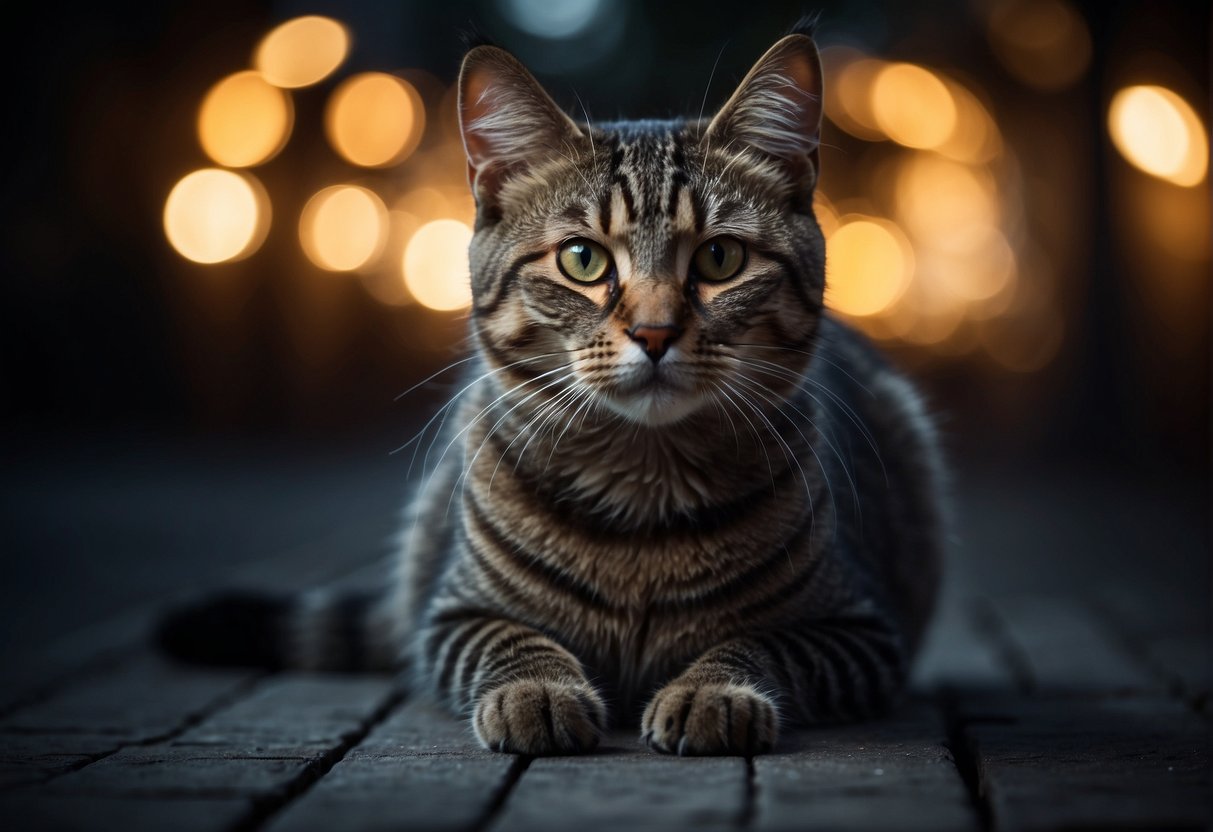
Unlike humans, who are well adapted to daylight vision, cats are creatures of the dusk and dawn. Their retinas have a high number of rods, the photoreceptor cells that are sensitive to low light.
Watching your cat slink effortlessly through a dimly lit room, it’s clear that these animals are built for twilight activity. They can detect movement swiftly and navigate spaces with ease when we might be squinting and stumbling.
However, it’s important to understand that while cats’ night vision outperforms humans, it has its limitations in pitch-black environments.
They require some level of light to see, even if it’s very faint. Their whiskers and acute hearing also assist in navigation, compensating for visual data when it’s too dark.
How Feline Vision Works At Night
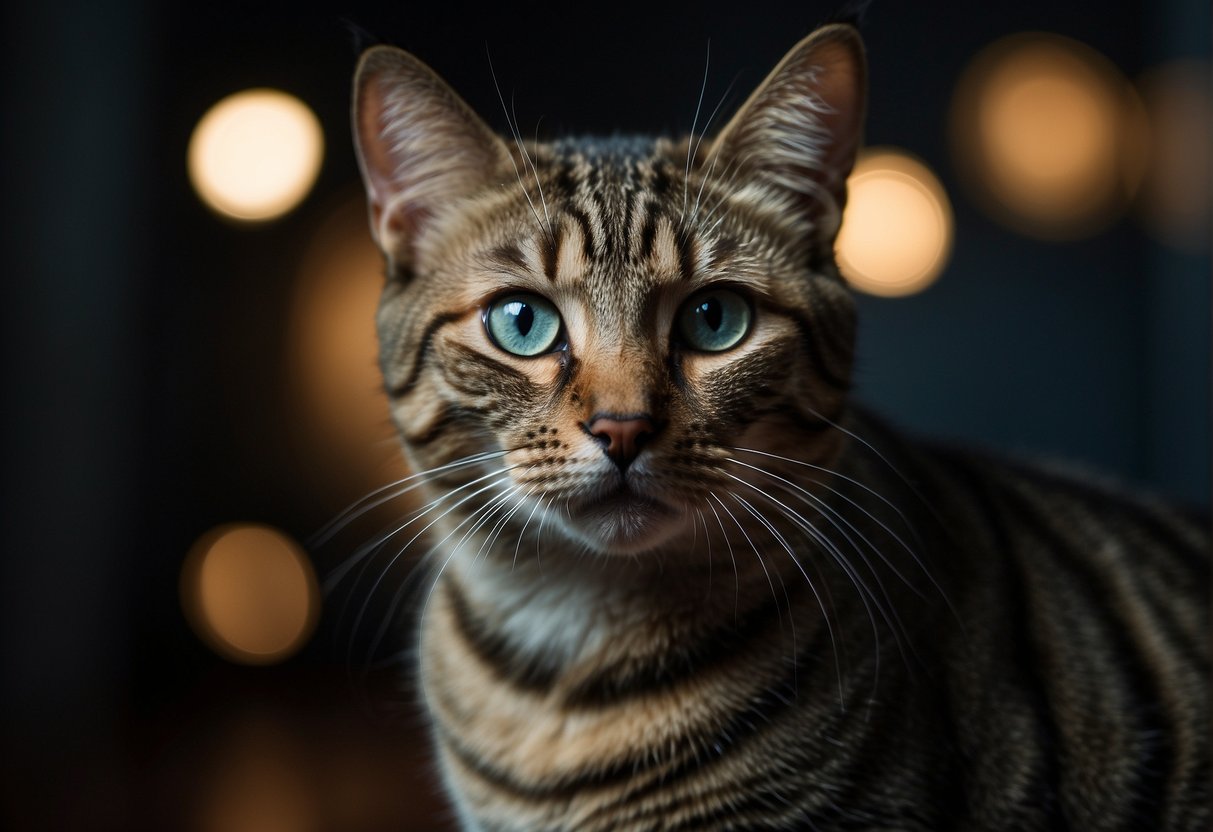
Understanding the anatomy of their eyes helps to appreciate how they navigate the world so effortlessly after dusk.
Role of the Retina and Photoreceptors
Your cat’s retina contains two main types of photoreceptors: rods and cones. Rod cells are incredibly sensitive to low light, making them key players in night vision. Felines have a high number of rods, which allows them to detect motion and see in dim conditions much better than we can.
On the other hand, cone photoreceptors are responsible for day vision and color perception. Although cats have fewer cones than humans, they can still distinguish between some colors.
The tapetum lucidum, a mirror-like layer behind the retina, reflects light back through the retina, increasing the light available to the photoreceptors. This is what gives your cat’s eyes that distinctive shimmer when caught in light at night.
Understanding Pupil and Cornea Structure
If you’ve noticed your cat’s pupils change size, that’s because they can dilate significantly to let in more light. This ability is crucial for adapting to various levels of brightness. The pupils can expand to cover almost the entire exposed surface of the eye, allowing maximum light absorption.
The shape of the pupil in a cat is also unique — usually vertical slits that can open wide in the dark and close to thin lines in bright light, which provides a wide range of light levels that their eyes can regulate.
Cats also benefit from having large corneas relative to the size of their eyes. The rounded shape of the cornea functions to capture and focus ambient light, enhancing their ability to see when it’s dark.
Cats in Low Light Conditions
Cats are remarkable creatures with adaptations that allow them to navigate and hunt efficiently in low-light conditions. This section explores the specific features that enhance their nighttime capabilities and how color perception plays a role in their low-light vision.
Adaptations for Nighttime Hunting
Your cat’s eye structure is key for nighttime prowling. Large corneas and pupils allow maximal light entry, optimizing their visual acuity in dim conditions where we might struggle to see anything at all.
The retinas of cats are densely packed with cells called rods, which are more sensitive to light and motion, enabling them to detect even the slightest movements of prey during the twilight hours.
- Reflective layer behind the retina: Known as the tapetum lucidum, this acts like a mirror, reflecting any light passing through the retina back into their eyes, thus giving them a second chance to use this light.
- Slit-shaped pupils: These can expand remarkably wide in low light to let in more illumination, but they can also contract to a tiny slit to protect the sensitive retina from bright lights during the day.
Color Perception and Low-Light Vision
Cats don’t see in complete darkness, but their vision surpasses ours in dim conditions. Though not colorblind, cats perceive color differently; they favor blues and greens and are less sensitive to wavelengths near the red end of the spectrum.
However, color is not the primary concern when cat night vision kicks in. In the dusk, when most of us would need to switch on a light, your cat can still distinguish objects and navigate quite well.
- Rods vs. Cones: The retinas of cats have a high concentration of rods for low-light vision and fewer cones, which are responsible for color vision and visual detail.
- Intermediate light levels: In these conditions, your cat’s visual acuity is superior. Ever notice how your cat can pounce on the tiniest of toys in a dimly lit room? That’s this low-light superiority in action.
Comparative Vision: Cats versus Humans
When you think of cats slinking through the shadows or pouncing on a toy in a dimly lit room, you’re witnessing their remarkable adaptations for seeing in the dark—a sharp contrast to human vision capabilities.
Differences in Nighttime Visual Capabilities
Cats are the masters of low-light hunting, thanks to their exceptional night vision. Unlike humans, who might stumble in the dark searching for a light switch, cats can navigate quite gracefully. What’s their secret?
Cats have a high number of rod cells, which are more sensitive to low light, compared to humans. Additionally, their large pupils and a reflective layer behind the retina, called the tapetum lucidum, greatly enhance their ability to see in the dark.
This gives them an edge during dawn and dusk, also known as crepuscular hours, when they are most active.
You might notice that, while humans see vibrant colors in daylight, cats seem less responsive to color. This is due to cats possessing fewer cone cells than humans. While you enjoy a rainbow of colors, your feline friend perceives the world in a range of blues and yellows, making their color vision somewhat muted.
Evolutionary Reasons for Variance in Vision
The difference between your vision and your cat’s vision stems from evolutionary needs. Cats evolved as ambush predators; their vision is optimized to detect the slightest movements, particularly during their peak hunting times at dawn and dusk.
Their slit-shaped pupils can rapidly adjust to changes in brightness, allowing them to quickly spot prey or avoid predators.
Human eyes, on the other hand, evolved under different circumstances. Our ancestors needed to recognize a wide array of colors and details to gather edible plants and fruits. Sharp daytime vision and color differentiation were essential, which is why our eyes are equipped with more cone cells.
Our circular pupils are not as efficient as cats’ in changing light conditions, but they’re sufficient for our diurnal lifestyle.


My name is James, and welcome to FAQCats!
Along with our team of cat owners, expert pet enthusiasts, and pet professionals, we aim to write engaging helpful, engaging content about cats. At FAQCats we strive to provide content that’s accurate and fun to read. Our team writes about everything related to cats; even the most complex of topics. Through extensive research and caring for our own fur-pals, we’re able to provide something cat owners worldwide will love. Have a look around, and leave us feedback anytime!