
If you notice an abnormality on your cat’s skin while petting your cat, as a caring pet owner, it may cause you to worry. While many different conditions could result in a raised lump somewhere on your cat’s skin, there is a chance it could be a wart.
It is uncommon but possible for a cat to get a wart on its paw pad or anywhere else on its body or head.
If you are unsure how to tell if it’s a wart, look for the following characteristics. Warts typically look like small raised growths, ranging in color from white, skin color, black, or pink. They are usually soft to the touch and may grow in size over time. If you suspect that your cat has developed a wart on its paw pad, it is worth mentioning to their vet to see if they can take a look to officially diagnose it.
Your vet should be able to provide additional guidance around the best next steps for your cat’s wart. Warts are useless and harmless, but the paw pad is sensitive as a cat carries its body weight on its paw pads while walking.
Due to the location, the vet may recommend removing the wart before it can grow any bigger. If your vet is concerned about a particular lump or wart on a cat, they may recommend sending it off for a biopsy to ensure it is a benign lump.
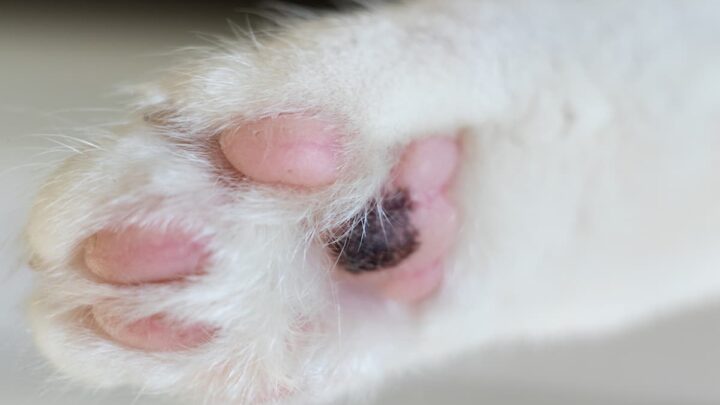
Can I remove a cat’s wart at home?
It is not recommended for you to try and remove a wart on your cat’s paw pad at home by yourself. Removing a wart improperly can cause your cat pain and lead to a secondary infection.
Warts typically do not go away on their own, so if you are tempted to remove them, consult your cat’s vet for guidance on what removal method they recommend. Many vets may recommend you leave your cat’s wart alone until you can determine if it is causing them pain.
Are warts dangerous for cats?
Warts are not considered highly dangerous for a cat as long as the wart is benign and is not causing your cat any distress. If a wart is on your cat’s paw pad, the vet may recommend removing it simply to ensure the wart doesn’t hurt your cat while they walk.
Warts rarely are related to more severe conditions for a cat, but they can be a reoccurring incident. Once your cat has one wart, it is common for the wart to repeatedly grow back in the same spot. Due to this, warts can become a frustrating chronic problem for your cat if a wart continues to grow back in an inconvenient spot.
The worst-case scenario is for the vet to take a biopsy of your cat’s lump and for the findings to show that the cells are cancerous. If this is the case, it will be clear your cat did not have a wart after all but rather a cancerous tumor that has turned into a lump. While this is upsetting news, catching cancerous tumors early is the best-case scenario.

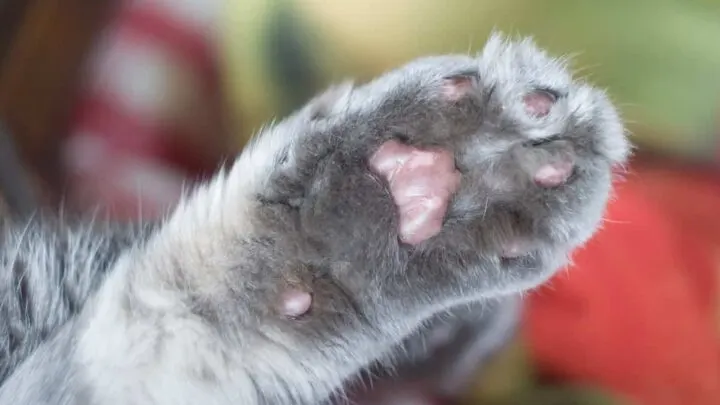
What causes warts on cats?
Warts are not common on cats, so you might be curious how your cat ended up with one on their body. While they are fairly uncommon, warts can be transmitted in a couple of ways. Warts can be transferred between animals, so there is a chance your cat could have picked up their warts from another cat it interacted with. Wart transmission between cats is more likely if you have an outdoor cat that plays with other cats outside.
Sometimes cat warts grow independently without transmission due to old age or underlying disease. If your cat has a compromised immune system or has recently been ill, you may notice more lumps, warts, and bumps while petting its fur.
Regardless of the cause of your cat’s warts, it is always a good idea to monitor any growths you see on your cat to see if they are growing or changing shape. Also, keep an eye on your cat to see any notable changes in its appetite or mannerisms. Changes in your cat’s behavior can signify that they are dealing with an underlying health condition.
What other growths can look like warts on a cat?
Several other conditions can mimic the symptoms of a wart on your cat’s paw pad. Some cats develop calluses or blisters on their paws from overactivity or irritation. Bacterial infections can also cause growths to form on your cat.
Cats can also get a cutaneous horn, which is a growth that looks like an extra toenail and is hard to the touch. These growths are caused by an overgrowth of keratin in your cat (AHNA). While it might be alarming to discover this on your cat’s foot, there is usually no cause for concern. If you believe the growth is affecting your cat’s balance or walking, the vet may be able to trim it down without causing your cat any pain.
Can my cat give me their warts?
Your cat cannot transmit its warts to you via contact. You do not have to worry that if you touch your cat’s warts, you will get one as well. While humans can develop warts on their bodies, warts cannot be transmitted outside of a species. Humans can transmit their warts to other humans, and a cat with warts can transmit its warts to other cats, so it is advised to keep your cat away from other cats if you have discovered warts on its body.
Even though warts are not serious, it is better to avoid having your cat spread them around. They can be a source of irritation and potential pain for your cat, and it will save you trips to the vet if your cat avoids contracting warts altogether.

My name is James, and welcome to FAQCats!
Along with our team of cat owners, expert pet enthusiasts, and pet professionals, we aim to write engaging helpful, engaging content about cats. At FAQCats we strive to provide content that’s accurate and fun to read. Our team writes about everything related to cats; even the most complex of topics. Through extensive research and caring for our own fur-pals, we’re able to provide something cat owners worldwide will love. Have a look around, and leave us feedback anytime!