
Whether you have two or more cats or see a colony of stray cats outside, you may wonder if cats help each other out. Humans do it, after all. You may, therefore, begin to ask: Will cats protect each other?
Yes, cats will protect each other. Cats that live with each other or are bonded will protect each other. Some cat breeds are also predisposed to loyalty. Cats will also band together to protect their territory. Cats will protect themselves and others by hissing, spitting, growling, taking a battle stance, and clawing.
Cats may fight with each other occasionally, but they will also protect each other for many reasons. I’ll take you through reasons why cats protect each other and how you can tell if your cat is getting ready to fight against a foe.

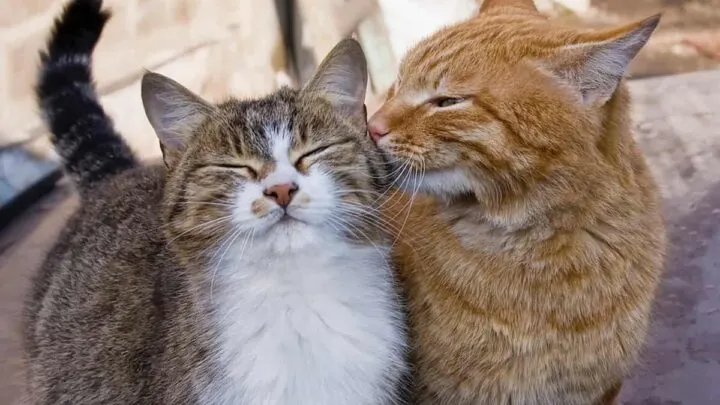
Why Do Cats Protect Each Other
There are a few different reasons why cats protect each other.
The Cats Live In The Same Household
Even though some people think that cats are solitary – even if you have a few cats – that is not always the case.
Cats that live in the same household are likely to support each other in the face of an outside predator, even if they may fight at home too.
Cats see each other as being in the same social circle or colony, much like a group of friends at school.
Your cats may swat at each other any chance they get, but when danger comes, they will likely help each other.
The Cats Are Bonded
Bonded cats are most likely to protect each other.
Bonded cats go one step further than cats that are simply in the same household.
Bonded pairs can be:
- Siblings
- Strays living together
- Cats that spent most of their lives together
Bonded cats do not like to be separated and will protect each other as much as they will play with each other for something to do.
Breed-Specific Traits Promote Loyalty
Certain cat breeds are so loyal that they will protect other cats.
Some cat breeds are extremely loyal, which means they will protect other cats, whether they are in the same household, in a bonded pair, or fighting against the same enemy.
Some of the most loyal cat breeds are:
- American bobcat
- Scottish fold
- Somali
- Tonkinese
Other breeds, like the Ragdoll or the Birman, are also loyal, but they are also gentle, lowering the chances of being a protector.
Territory Protection
Cats, whether they get along or not, love territory and will protect it.
Even cats that are not friendly with each other will come together to protect their territory if it is under attack.
This can happen in cases like:
A colony of cats getting attacked by raccoons
A neighborhood dog attacks a cat
The dog in your house goes after a cat
There is an intruder in your home.
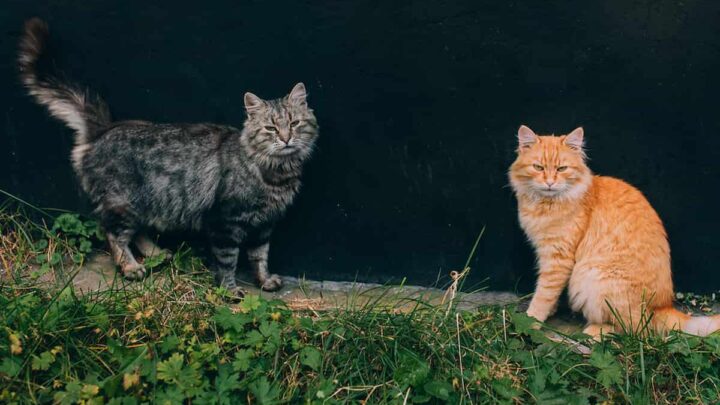
What Will Cats Do When They Protect Each Other
Cats will not put up fists during a fight, but there are warning signs and actions cats will take when protecting themselves and each other.
Hissing, Spitting, And Growling
Most cats will start by hissing to warn that they are unhappy.
Almost every owner has heard their cat hiss or growl for several reasons. Their cat can be upset, see a new cat, or feel annoyed by you.
Hissing is a cat’s way of saying, “Hey, I’m not happy!” A hiss should not be ignored if you do not want a cat’s aggression to continue.
Spitting is another way a cat can take out its aggression and warn you or another predator that they are unhappy.
Take A Battle Stance
Cats will take what you may call a “battle stance” when preparing to attack.
Look at this chart to learn about some differences between a cat on the offensive and a defensive cat.
| Offensive | Defensive |
| A stiff, lowered tail | Crouched position |
| Facing predator directly and staring with small pupils | Dilated pupils without a direct stare |
| Stiff legs | Ears pulled back toward the head |
| Hair standing on cat’s back and tail, most commonly | Tail tucked against body |
Your cat’s position will alert you to whether your cat’s fight or flight is kicking in.
Claw
Claws are a cat’s best protection.
Although some might think that cats are likely to bite when attacking, a cat’s claws are actually the weapon of choice.
If your cat has ever swiped you, you know that a cat’s nails are:
- Thin
- Sharp
- Long, even if they are scratched down by being outside
A cat may very well bite, but cats can also swipe at long ranges, grab a predator with claws, or injure the predator.


My name is James, and welcome to FAQCats!
Along with our team of cat owners, expert pet enthusiasts, and pet professionals, we aim to write engaging helpful, engaging content about cats. At FAQCats we strive to provide content that’s accurate and fun to read. Our team writes about everything related to cats; even the most complex of topics. Through extensive research and caring for our own fur-pals, we’re able to provide something cat owners worldwide will love. Have a look around, and leave us feedback anytime!