

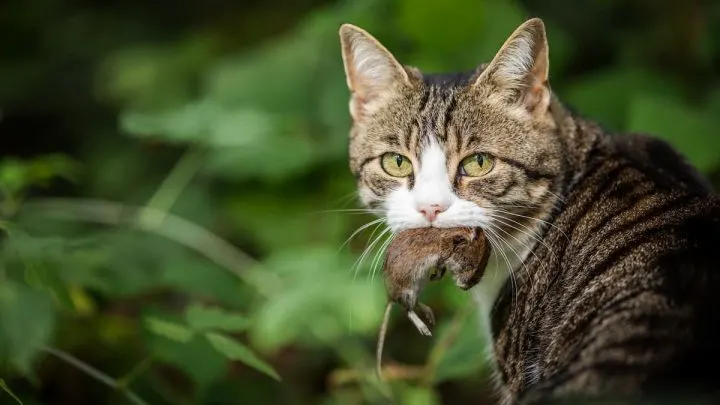
If your cat is like many, they like to hunt. It is instinctive for a cat to hunt even though they may be very well fed. Whether it is mice, spiders, or geckos, there is a good chance that your cat will chase after it. And eat it once caught! If this is the case for your cat or cats, you have probably asked yourself, can cats get sick from eating mice?
Cats can get sick from eating mice. Mice that have parasites such as worms or fleas can harm your cat. Equally, if the mouse has ingested toxins designed to kills it, your cat can become sick if it eats the mouse.
In this article, we will be answering whether cats do eat mice and whether it is safe for them to do so. We will also be looking at what happens when a cat eats a mouse, the diseases that mice are known to carry, and what can happen if your cat ingests a mouse that itself has consumed poison.


Do Cats Really Eat Mice
Yes, some cats really will eat, or partially eat mice. Often, they will want to share their prize with you, which is why you may find a tail, innards, or torso on your doormat. If you find a mouse head, consider yourself lucky. That is the best bit!
If you are anything like the author, it is baffling that your cat is not hungry! – would want to chow down on the mouse it has just caught. Indeed, is it harder to eat a mouse than the bowl of food presented just an hour ago?
Cats have a natural desire to hunt, even if they are not hungry. It is their instinct, and it is not going to change.
Naturally, different cats will behave differently. Some cats are just lazy and do not want to chase a mouse. Some will catch the mouse but not eat it. However, others are natural-born killers, and as soon as they spot a mouse, they go into the hunt and kill mode.
Cats need Taurine, which is an amino acid. Taurine helps to support vision, the immune system, heart function, and digestion.
Cats require a lot of Taurine but do not produce enough of it naturally, so get Taurine through their diet. Taurine is found in meat. As obligate carnivores, cats in the wild get their required Taurine from their prey. Domestic cats obtain it through kibble, which has Taurine added.
If your cat’s diet is not kibble or meat-heavy, they could be eating mice because they feel the need to top up their Taurine levels. Similar to when a cat eats grass to obtain vitamins or to make them vomit.
Is It Safe For Cats To Eat Mice
Generally, it is safe for cats to eat mice if it is healthy, disease and pest-free. However, the majority of wild mice are riddled with fleas, parasites, and bacteria. If your cat eats a wild mouse, there are some potential health hazards to be had.
As obligate carnivores, cats do have the digestive system to process a meal of mouse. Raw bones contain minerals such as phosphorus, potassium, calcium, and magnesium. All minerals that a cat needs to stay healthy.
Additionally, chomping and chewing bones can be good for a cat’s oral health. While not only satisfying any instinct your cat may have to chew but crunching down on bones can also strengthen teeth.
Mice bones can clean any build-up of plaque or tartar from your cat’s teeth.
When eating a mouse, your cat may choose to discard some parts of the mouse.
The most likely to be left behind in the stomach. Quite simply, stomachs filled intestines and stomach acid does not taste great. Unless your cat is starving, they will not be touching the stomach.
Your cat may also leave the tail of a mouse. This is most likely because the tail has a different texture and is chewier than the rest of the body. Remember, cats only have sharp pointy teeth designed for tearing flesh. A chewy mouse tail, when the cat is not starving, is going to be discarded.
Cats seem to love eating the head of a mouse. If your cat has left parts of the mouse behind, there is a good chance there will not be a head as they are tasty – to a cat – and full of vitamins and minerals.
Should I Let My Cat Eat Mice
It is safe for your cat to eat healthy, clean mice. But, as most wild mice do not come with a contents label, you should not let your cat eat wild mice.
Historically, cats were incorporated into a household to keep rodents at bay. Indeed, most were left outdoors and not allowed inside the home.
It is only at the end of the 19th century that the practice of keeping cats indoors became more popular, despite the symbiotic relationships between cats and humans dating back thousands of years.
There are some famous ‘working’ cats recruited specifically to catch or deter rodents. These include ‘Mouse Keeping’ Pál from Iceland and ‘Chief Mouser’ Larry from Number 10 Downing Street in England.
It is not easy to stop your cat from doing anything, especially eating mice. If you see that your cat has caught a mouse, and you do not know the origin of the mouse, you should remove the mouse and dispose of it as quickly as possible.
When doing so, make sure you do not come into close contact with the dead mouse. Wear gloves or scoop the mouse up using a garden trowel or piece of cardboard.
Most wild mice carry parasites and fleas, some of which can harm humans and your cat.
As cats like to ‘play’ with their food, it would be recommended that you take a dead mouse off your cat before or while they are playing with it, especially if your cat has brought the mouse inside of your home.
Your cat will be unconsciously spreading germs that could make you or your cat sick later down the line.
Is It Bad For My Cat To Eat Mice
It can be bad for your cat to eat mice. Depending on the mouse’s health, your cat could end up with parasites or bacteria that can make them sick.
Wild mice are notoriously dirty animals. The majority of mice have parasites; even if your cat bites a mouse and does not eat it, there is the risk of getting infected by parasites. Here is a list of some of the parasites that mice can carry;
- Toxoplasma Gondii –Toxoplasma Gondii is the parasite that causes toxoplasmosis, a severe illness for some humans. In cats, it presents mild symptoms, but if your cat is immune-compromised, it can lead to illness and long-lasting health issues. Symptoms include ear twitching, fever, respiratory issues, and vertigo.
- Taenia taeniaeformis –Taenia taeniaeformis is a type of tapeworm; it is a parasite that uses a mouse as its host and a cat to reproduce. Although not immediately life-threatening, it can cause anemia in your cat.
- Dipylidium Canium – Dipylidium cranium is another type of tapeworm that is caused by the ingestion of fleas. Mice carry fleas, so it is included here. Like Taenia taeniaeformis, it can lead to anemia if left untreated.
- Ticks – Ticks are arachnids that use cats and mice as their host. A bite from these blood-sucking parasites can lead to babesiosis in humans as ticks carry the babesia parasite. Babesiosis is a malaria-like illness. Ticks are also linked to Lyme disease, Tularemia, and Tick-Borne Relapsing Fever.
- Fleas – Fleas can carry the larval stage of dipylidium cranium. Flea feed on the blood of a cat. For kittens, a bad flea infestation can lead to severe anemia and death. Fleas are vital to the transmission of ‘cat scratch disease’ between humans and cats.
What Happens If My Cat Eats A Mouse
If your cat eats a healthy mouse, it will digest the mouse in about 10-24 hours. A cat’s digestive system is designed to process meat, bones, and even fur.
If your cat eats a mouse infected with parasites, there is a high chance that those parasites will transfer hosts. Your cat could end up with worms, fleas, ticks, bacteria, or disease.
If your cat eats a mouse with ingested mouse or rat poison, it can make your cat very sick.
When you realize that your cat has eaten a wild ‘unknown’ mouse, monitor your cat closely for any signs of illness or distress. If you are unsure, then consult your veterinarian for advice and take your cat in for treatment.
Can Cats Get Sick From Eating Poisoned Mice
Yes, cats can get sick from eating poisoned mice. This is called secondary toxicosis, secondhand poison consumption.
Mice are considered a pest by many people and, other than keeping cats, various things are done to keep their populations down. One of the most popular is to lay poison for mice.
Usually known as rodenticide, these poisons are designed to attract and kill all manner of rodents – chipmunks, squirrels, rats, and mice, to name a few.
Different brands have different strengths or work in different ways, so depending on which brand it is that the mouse has consumed depends on how it will affect your cat.
Some single-dose rodenticides have a delayed reaction, and it can be two or three days before the mouse will die. This gives it plenty of time to be caught by your cat.
Your cat may not demonstrate any poisoning symptoms straight away, and it could take a day or two before the poison in the consumed mouse affect your cat.
Signs to look for include muscle spasms, reduced appetite, pale gums, bleeding from orifices, lethargy, and weakness. Immediate veterinarian care is required. The care can be invasive, but it is necessary.
The other thing to be aware of is that some rodenticides are toxic when consumed and give off toxic fumes.
So, your cat may not be eating the mouse but could be playing with an already dead one. If the ‘play’ breaks open the skin or ruptures the stomach of the carcass, your cat could get sick from inhaling the by-product gases.
Will A Poisoned Mouse Kill A Cat
Depending on the rodenticide that the mouse consumed, a poisoned mouse can kill a cat. Some single-dose poison, which a certified pest controller can only administer, could wipe out your cat pretty quickly. Below is a list of some known rodenticides and how they work.
- Anticoagulant Rodenticides (ACR) prevents the production of Vitamin-K-dependent blood-clotting elements. If your cat consumes a mouse that has consumed an ACR, there are antidotes for it. However, left untreated, ACR can prove fatal.
- Bromethalin causes brain swelling in cats that have consumed mice that have eaten bromethalin. While there is no antidote for Bromethalin consumption, induced vomiting, IV fluids, administration of activated charcoal, anti-seizure medication, and round-the-clock care can help your cat.
- Cholecalciferol (Vitamin D3) is a nasty, fast working poison of which only a tiny amount is needed to make things serious for your cat. As the name suggests, this poison raises the calcium in the cat’s body to dangerous levels. Too much calcium leads to kidney failure. There is no antidote, and consuming this requires at least a week’s hospitalization, with the body being flushed of the excess calcium.
- Strychnine is a fast-acting poison absorbed through the stomach and can fatally affect the central nervous system. There is no cure, so treatment is aggressive stomach pumping and administration of active charcoal.
- Zinc Phosphides can be poisonous to you, your family, and the veterinarian, so extreme care is needed when handling your cat if you suspect that they suffer from secondary toxicosis with zinc phosphide. Zinc Phosphides are usually used for larger rodents rather than mice. If your cat vomits, wear a mask when cleaning it up and aerate the vomit area as noxious gases are produced in the stomach with this poison.
Can Cats Get Rabies From Eating Mice
It is unlikely that your cat will catch rabies from eating a mouse. Mice are rarely found to be infected with the rabies virus.
However, you should always maintain and upkeep your cat’s anti-rabies vaccinations so that it does not contract rabies from other wild creatures – such as raccoons or bats – that do carry the virus. If you are not sure if your cat’s vaccinations are up to date, consult a veterinarian.
What Diseases Can Cats Catch From Mice
There are several diseases that cats can carry or transmit due to eating or close contact with a mouse. Below, we have provided a list of some of the diseases associated with mice that can be transmitted to your cat and possibly you!
Leptospirosis – Mice are known carriers of the bacteria that cause Leptospirosis in cats and humans! Symptoms are flu-like but, if undetected or left, can lead to kidney damage, meningitis, respiratory issues, liver failure, or death in immune-compromised people.
It is possible to vaccinate your cat against Leptospirosis, although there are many strains of the bacteria – leptospires – so 100% protection is not guaranteed. But it is worth doing.
Plague – What a word to hear in the 21st century! The Black Death in the mid-1300s was a pandemic of bubonic plague. Sadly, the plague is still around.
The bacteria that causes plague – Yersinia Pestis – is transmitted via flea bites from fleas found on mice and rodents. Cats, as well as humans, are susceptible to plague.
Bubonic plague manifests in cats with swelling of lymph nodes under the jaw. Pneumonic plague is in the lungs, and septicemic plague is in the blood.
Hantavirus – Hantavirus is a group of viruses from one family that all have their disease syndromes. Cats can be infected with Hantavirus, but it is not dangerous to them, and infected cats cannot spread it to humans.
However, Hantavirus is transmissible to humans from infected mice – dead or alive. Remember what was mentioned earlier about a cat playing with a dead mouse in the house?
Tularemia – Mice, and other rodents, carry the bacteria Francisella Tularensis which causes Tularemia, also known as rabbit fever. Cats are susceptible to it if they bite or eat an infected mouse. Tularemia causes a high fever, inflamed lymph nodes, jaundice, and organ failure.
Things To Consider
Toxoplasma Gondii was mentioned earlier in relation to cats, but it can be a severe illness for some humans.
If contracted from a mother during pregnancy, it can lead to recurring eye infections, hearing loss, and mental disability. For people with compromised immune systems, it can present lung issues and seizures.
For most healthy adults, symptoms will not manifest, and they can be harmless. Incidentally, research has shown that toxoplasma can permanently remove the fear that a mouse innately has of a cat.
When allowing your cat to interact with any wild animal, it always pays to be aware of diseases or bacteria that can be transmitted and whether it is safe for your cat to eat or ‘play’ with the wild creature.
In this article, we have focused on what hazards mice present to your furry friend. However, cats also hunt various other creatures, each of which can carry or transmit pathogens or poisons.
Whether it is a frog that sweats a toxin that is hazardous to your cat; or a lizard that can infect your cat with a parasitic liver fluke, it is best to monitor anything that kitty is playing with to keep them, plus yourself and family, safe.


My name is James, and welcome to FAQCats!
Along with our team of cat owners, expert pet enthusiasts, and pet professionals, we aim to write engaging helpful, engaging content about cats. At FAQCats we strive to provide content that’s accurate and fun to read. Our team writes about everything related to cats; even the most complex of topics. Through extensive research and caring for our own fur-pals, we’re able to provide something cat owners worldwide will love. Have a look around, and leave us feedback anytime!